
Consultation
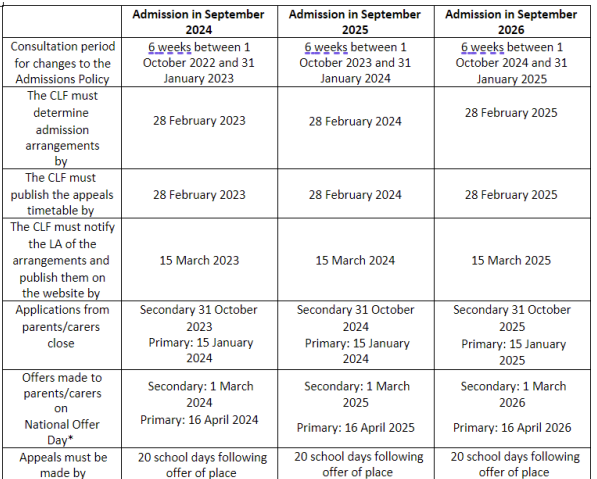
*National Offer Day is on the date specified or the next working day where the specified date is a
weekend or bank holiday.
Council is not required to take any actions.
Where there are more children than places available, a waiting list will operate. If parents would
like their child’s name to be added to the waiting list they must request it, as no child is added
automatically.
Term dates can be found on the academy’s website. Any application or appeal that is yet to be
processed will be considered for a vacancy along with those already on the waiting list. When
filling a vacancy, all those seeking a place at the time the decision is made (not at the time the
vacancy occurs) will be considered.
Children who are the subject of a direction by a Council to admit or those who are allocated a
school in accordance with the Fair Access Protocol, will take precedence over those on the
waiting list.
Priority will not be given on the basis of the date an application was added to the list. All
applications must be ranked in line with the admission authority’s oversubscription criteria and
any allocations will be made using this. Each child added to a waiting list will require the list to
be ranked again in line with the published oversubscription criteria. Waiting list positions can
go up as well as down as additional applicants are added to or removed from the waiting list
and ranked in accordance with the specific oversubscription criteria.
For UK Service Personnel and other Crown Servants, where possible, places may be allocated in advance of the pupils return to the UK provided the MOD, FCO or GCHQ have provided a letter declaring a return date and residency placement. Places may be offered and reserved up to one term in advance of the place being required. Somerset operates 6 terms per year. Children of UK Serving Personnel are excepted pupils for Infant Class Size outside the normal round of
allocations.
Each Local Authority must have a Fair Access Protocol, agreed with the majority of schools in its
area to ensure that – outside the normal admissions round – unplaced children, especially the
most vulnerable, are offered a place at a suitable school as quickly as possible. In agreeing a
protocol, the Local Authority must ensure that no school – including those with available places
– is asked to take a disproportionate number of children who have been excluded from other
schools, or who have challenging behaviour. The protocol must include how the Local Authority
will use provision to ensure that the needs of pupils who are not ready for mainstream schooling
are met. The Fair Access Protocol is available at www.n-somerset.gov.uk/fair-accessprotocolAdmissions of children outside their normal chronological year group (delayed or
accelerated entry)
Who can apply
Applications will be accepted for children who meet one or more of the following:
▪ they are resident in the UK
▪ they hold full British Citizen Passports
▪ they are from countries whose passports have been endorsed to show that
they have the right to abode in this country.
Applications for children who do not meet one of the above will not be accepted until the child
is in this country.
This includes all of those people, including carers, who have parental responsibility for a child
as set out in the Children Act 1989. All references within this document to parent(s) therefore
include carers.
A child’s home addressis considered to be the place where the child permanently and ordinarily resides for the majority of the time as at the closing date and time. This would normally be the same address as a person who has parental responsibility for the child and is their main carer.
An address used for childcare arrangements cannot be used as the home address. The address
of a child that is different from his/her parents where the move to this address is expressly
linked to obtaining a school place will not be accepted.
Where parents do not live together, and the child spends equal amounts of time with both
parents, the home will be considered to be that of the parent who made the application to be
the child’s home.
More than one address will not be accepted as the child’s home address. If necessary, the terms
of a residency order may clarify the home address. If parents share parental responsibility for the child, and both parents submit an application form, both parents will be asked to determine which application should be considered and which application should be withdrawn.
If parents are unable to reach an agreement, a Specific Issues Order or a residency order will be
requested to be seen for clarification on which address should be used. In the absence of any
Specific Issues or residency order, the home address will be considered to be that of the parent
with the primary day to day care and control of the child. In reaching this decision, evidence
may be requested from both parents. An example of evidence would be the address which is
registered with a medical GP. Parents are urged to reach agreement but where they do not, the
home address will be determined for them.
If a child is temporarily living away from his/her parents in a different Council area, the Council
where the child ordinarily lives will continue to be the home Council.
Whilst the place of residence of the child for the first round of allocations would normally be
his/her physical place of residence as at Closing Date and time for applications, it should be
noted that in certain circumstances and acting in the interests of the child, an alternative place
of residence may be used*, for example where a child is temporarily living away from his/her
parent’s home and the new temporary place of residence is the home where the child is likely
to be living whilst attending school.
*If necessary, this would be determined by North Somerset Council.
Parents must inform North Somerset Council if they change address as soon as possible or any
offer of a place may be withdrawn. If a change of address will occur after the closing time and
date (and before the start of term 1), and independent confirmation is submitted by the closing
time and date, it will be considered in the first round of allocations.
Examples of independent confirmation of a change of address are:
• a solicitor’s letter confirming the exchange of contracts with a completion date,
• a tenancy agreement signed by both parties,
• a utility bill dated within three months prior to submission.
If the child is from a family of a Crown Servant or of UK Service Personnel, a letter from the
MOD, FCO or GCHQ declaring a return date and residency area.
Applicants may also be required to provide proof that they have left the previous property, for
example by supplying a final account utility bill.
If a new address is not accepted for a round of allocations, where none of the parental
preferences can be offered, the alternative school offered will be based on the new address
(providing details and independent confirmation is received before the round of allocation has
been finalised).
Where a change of address is from one Local Authority to another, the Local Authority of the
new address, will then normally be the home Local Authority. The new home Local Authority
will then process the application and notify the parents of the outcome.
The Admissions Authority reserves the right to require documentary evidence of the
genuineness of a family address and if this is not produced, reserves the right to make its own
enquiries.
The child’s normal permanent home address where he or she lives with his or her parents or
legal guardians will be used to decide where the child lives. If parents or guardians plan to move
documentary evidence will be required.
Examples of evidence that may be acceptable to determine a child’s address are:
1. A solicitor’s letter confirming exchange of contracts and a completion date for a property
which is being purchased or a property which is being sold.
2. A copy of a signed rental agreement or a solicitor’s letter if moving to a Council or rented
property and proof of your sale or Notice to Quit on your current/previous property.
3. A copy of a council tax bill or utility bill such as water, gas or electricity in your name for
your newly owned or rented property together with proof of your sale or Notice to Quit on
your current/previous property.
4. If you are moving in with a relative a letter from them will be required confirming the date
you will be moving in together with a copy utility bill showing their name and address. A
solicitor’s letter will also be required confirming that completion of contracts has taken place
on your sale or Notice to Quit on your current/previous property.
Any letters/supporting documents should also be submitted to the Admissions Authority.
Whilst it is not the responsibility of other offices/schools, the Admissions Authority will use
discretion and may accept applications/documents received by other Councils, Schools or other Council offices that are passed to the School Admissions Team. They will be accepted as on time if Somerset Council feels they may have been submitted by the closing time and date.
The Admissions Authority reserves the right to withdraw an offer of a school place in certain
limited circumstances.
Examples include:
1. Where a parent has given fraudulent or intentionally misleading information such as a
false address, which effectively denied a place to a child with a stronger claim.
2. Where a parent has not responded to an offer within the deadline set or to any
subsequent reminder to reply within a further 7 days.
3. Where the offer was made as a result of an administrative error.
4. If children do not commence attendance at school at the date arranged for their child to
commence and the school is not given a satisfactory reason for the absence.
If a child or parent(s) move address but the parents do not inform the Admissions Authority,
this may be deemed to be intentionally misleading, and any place offered may be withdrawn if
it has denied another child a place.
Where before offers are made, an application is deemed to be fraudulent or intentionally
misleading the application will be considered on the basis of the correct information. It is the
parent’s responsibility to inform Somerset Council and the Admissions Authority if their contact
details change after making an application.
Children in Care are defined as follows:
• Children in Care’ are children who are (a) in the care of a local Council or (b) being provided
with accommodation by a local Council in the exercise of their social services functions (see
the definition in section 22(1) of the Children Act 1989).
• For Children previously in Care:
o this includes children who were adopted under the Adoption Act 1976 (see section 12
adoption orders) and children who were adopted under the Adoption and Children Act
2002 (see section 46 adoption orders
o child arrangements orders are defined in s.8 if the Children Act 1989, as amended by
s.12 of the Children and Families Act 2014. Child arrangements orders replaced
residence orders and any residence order in force prior to 22 April 2014 is deemed to be
a child arrangements order
o in accordance with Section 14A of the Children Act 1989, a Special Guardianship Order
is defined as an order appointing one or more individuals to be a child’s special guardian
(or special guardians)
o Children who appear (to the admission authority) to have been in state care outside of
England and ceased to be in state care as a result of being adopted are accepted and
adopted by the Authority.
To be considered as a brother orsister a child must be living at the same addressfor the majority
of the time (at least 50% of the time), as a full, half, step or adoptive brother/sister.
Full and adoptive brothers/sisters are defined as children who have the same biological or
adoptive parents.
Half-brothers/sisters are defined as children who share only one biological or adoptive parent.
Stepbrothers/sisters are defined as children who are not necessarily related biologically
(including foster children) but are living in the same household for the majority of the time at
the address the Admissions Authority considers to be the address of the child for whom the
application is made. to
It is the responsibility of parents to ensure that they declare on their application if they have a
child (or have been allocated a place for a child) at their preferred school(s) or to inform the
Admissions Authority if a child obtains a place after they have applied.
A brother or sister must be attending (or is expected by the Admissions Authority to be
attending) the school at the time of admission. A child attending a nursery/pre-school part of a
school does not count as a brother or sister attending the school at the time of admission.
A direct line distance is where distances are measured in a straight line between the address
point of the child’s home and the main entrance marker for the school, indicated on North
Somerset Council computerised system(s). Unless stated otherwise, where the direct line
distances are equal, the ranking of applications will be determined by drawing lots.
If it is not possible to measure a distance on North Somerset Council computerised system(s),
North Somerset Council will use alternative methods.
Admissions of children outside their normal chronological age group (delayed or accelerated
entry)
Admissions of children outside their normal chronological age group (delayed or accelerated
entry): Applications for delayed or accelerated entry in cases where parents would like their
child to be admitted to a year group that is not the chronological age year group, will be
considered.
The admissions authority for the school will make the final decision. In addition, parents of
summer born children (born on or between 1 April and 31 August) can request to admit their child into the Reception year, one year after they would normally enter the school. The
admissions authority for the school will make the final decision.
Decisions will be made on the basis of the circumstances of each case and in the best interests
of the child. This will include taking account:
• the parent’s views;
• information about the child’s academic, social and emotional development;
• where relevant, their medical history and the views of a medical professional;
• whether they have previously been educated out of their normal age group;
• whether they may naturally have fallen into a lower age group if it were not for being
born prematurely.
The admissions authority must also take into account the views of the head teacher.
Parents will need to write to the school to request that their child starts a year later or earlier
than their chronological age. Parents will need to give reasons for the request and details of the
child’s particular needs. Any reports or evidence to support your request should also be
enclosed.
For Reception and Junior intake applications, it is advised that an on-time application is
submitted for the correct chronological year group. If the delay/accelerated request is agreed,
the on-time application can be withdrawn, and a new application should be made the following
year. If the request is not agreed, and the child stays in their chronological age group, the ontime application can still be processed. If a request is not agreed and the child does not have an
on-time application, then a late application would need to be submitted.
Where the admission authority agrees to a parent’s request for their child to be admitted out
of their normal age group the parent must apply according to the timescales of the agreed
admission cohort. The application will be processed as part of the main admissions round
(including applying the oversubscription criteria where applicable), unless the parental request
is made too late for this to be possible. Parents have a statutory right to appeal against the
refusal of a place at a school for which they have applied and been refused. This right does not
apply if they are offered a place at the school, but it is not in their preferred age group. Where
the admission authority does not agree a request for a summer born child to be admitted into
the Reception Year Group, the parent may apply for their child to be admitted with their
chronological age group for admission at the time they would normally enter the school. Such
children who do not start school in the school year that they become 5 will normally be placed
in a Year 1 class and will miss the Reception year.
All applicants refused a place have a right of appeal to an independent appeal panel constituted
and operated in accordance with the School Admission Appeals Code. Details of how to appeal
are included in the outcome email or letter.
Statement of Special Educational Needs or Education, Health and Care Plan
Applicants in receipt of a Statement of Educational Needs or Education, Health and Care Plan
should contact their SEN Officer to apply for schools.
It should be noted that this policy is subject to alteration to reflect any changes in legislation,
case law, Council policy or to ensure legal compliance.
Contact Details: For further information, contact info@mwa.clf.uk